


Forging the Third Pole: Permafrost Science and the Trans-Polar History of the Qinghai-Tibet Railway, 1956–2006 (Mr. Jason Chan, Harvard University)
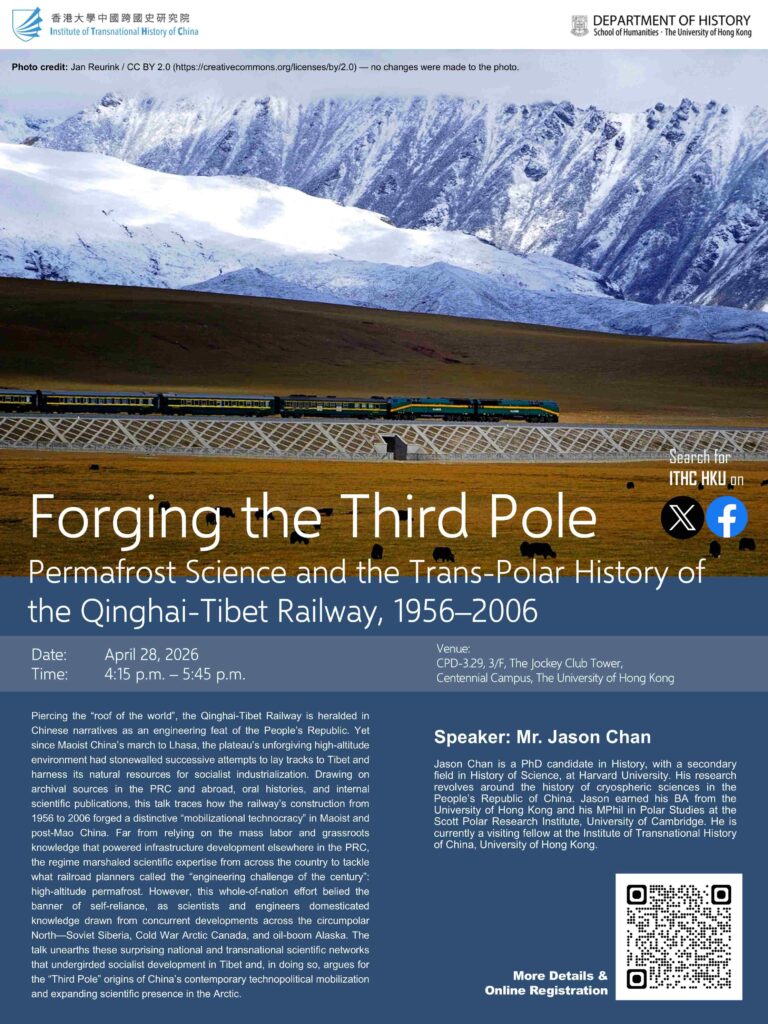
Online Registration Date: April 28, 2026 Time: 4:15 p.m. – 5:45 p.m. Venue: CPD-3.29, 3/F, The Jockey Club Tower, Centennial Campus, The University of Hong Kong Piercing the “roof of the world”, the Qinghai-Tibet Railway is heralded in Chinese narratives as an engineering feat of the People’s Republic. Yet since Maoist China’s march to Lhasa, the plateau’s unforgiving high-altitude environment had stonewalled successive attempts to lay tracks to Tibet and harness its natural resources for socialist industrialization. Drawing on archival sources in the PRC and abroad, oral histories, and internal scientific publications, this talk traces how the railway’s construction from 1956 to 2006 forged a distinctive “mobilizational technocracy” in Maoist and post-Mao China. Far from relying on the mass labor and grassroots knowledge that powered infrastructure development elsewhere in the PRC, the regime marshaled scientific expertise from across the country to tackle what railroad planners called the “engineering challenge of the century”: high-altitude permafrost. However, this whole-of-nation effort belied the banner of self-reliance, as scientists and engineers domesticated knowledge drawn from concurrent developments across the circumpolar North—Soviet Siberia, Cold War Arctic Canada, and oil-boom Alaska. The talk unearths these surprising national and transnational scientific networks that undergirded socialist development in Tibet and, in doing so, argues for the “Third Pole” origins of China’s contemporary technopolitical mobilization and expanding scientific presence in the Arctic. Speaker: Mr. Jason Chan Jason Chan is a PhD candidate in History, with a secondary field in History of Science, at Harvard University. His research revolves around the history of cryospheric sciences in the People’s Republic of China. Jason earned his BA from the University of Hong Kong and his MPhil in Polar Studies at the Scott Polar Research Institute, University of Cambridge. He is currently a visiting fellow at the Institute of Transnational History of China, University of Hong Kong.
Workshop “Chinese Workers During the Great War”
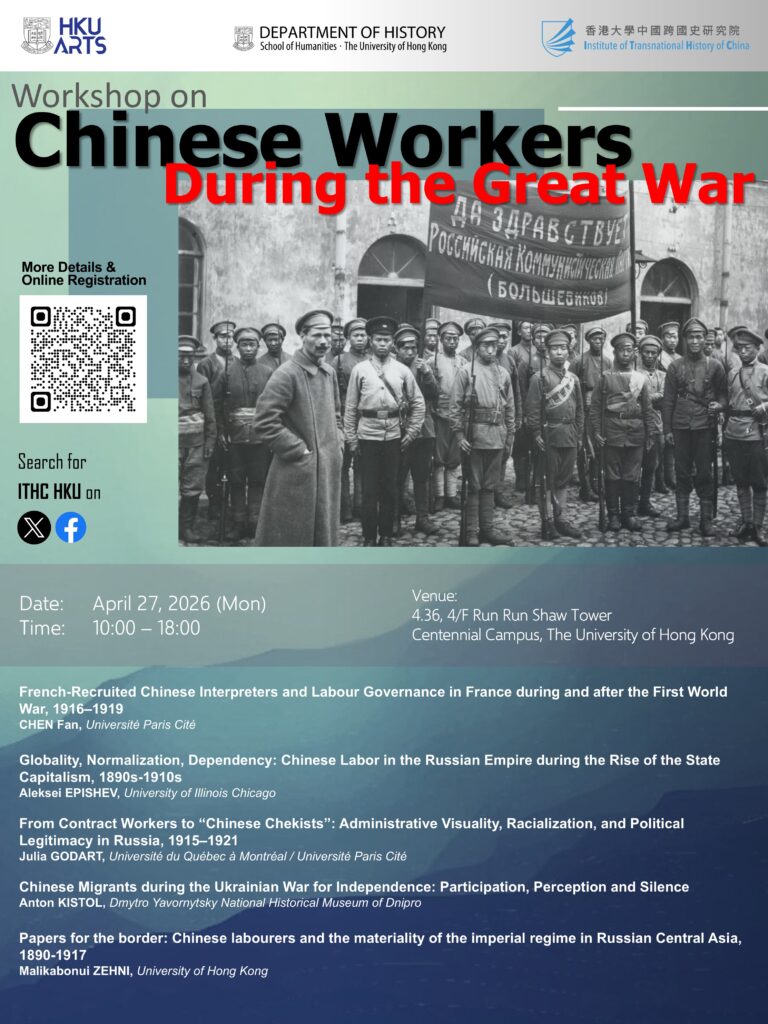
Online registration Date: April 27, 2026 Time: 10:00 – 18:00 Venue: 4.36, 4/F Run Run Shaw Tower, Centennial Camous, The University of Hong Kong Program Rundown 9:45 – 10:00Registration 10:00 – 10:20Welcome RemarksDavid POMFRET(Dean, Faculty of ArtsThe University of Hong Kong) 10:20 – 11:20French-Recruited Chinese Interpreters and Labour Governance in France during and after the First World War, 1916–1919CHEN Fan (Université Paris Cité) 11:20 – 12:20Globality, Normalization, Dependency: Chinese Labor in the Russian Empire during the Rise of the State Capitalism, 1890s-1910sAleksei EPISHEV (University of Illinois Chicago) 12:20 – 14:00Lunch Break 14:00 – 15:00From Contract Workers to “Chinese Chekists”: Administrative Visuality, Racialization, and Political Legitimacy in Russia, 1915–1921Julia GODART (Université du Québec à Montréal / Université Paris Cité) 15:00 – 16:00Papers for the border: Chinese labourers and the materiality of the imperial regime in Russian Central Asia, 1890-1917Malikabonui ZEHNI (University of Hong Kong) 16:00 – 16:15Coffee Break 16:15 – 17:15Chinese and The Ukrainian Revolution (1917-1921)Anton KISTOL (Dmytro Yavornytsky National Historical Museum of Dnipro) 17:15 – 17:45Roundtable Discussion 17:45 – 18:00Closing RemarksXU Guoqi(David H Y Chang Professor in Chinese HistoryFounding Director, Institute of Transnational History of ChinaThe University of Hong Kong)
Roundtable Workshop “Fairbank in China Now: Contemporary Academic and Policy Legacies”
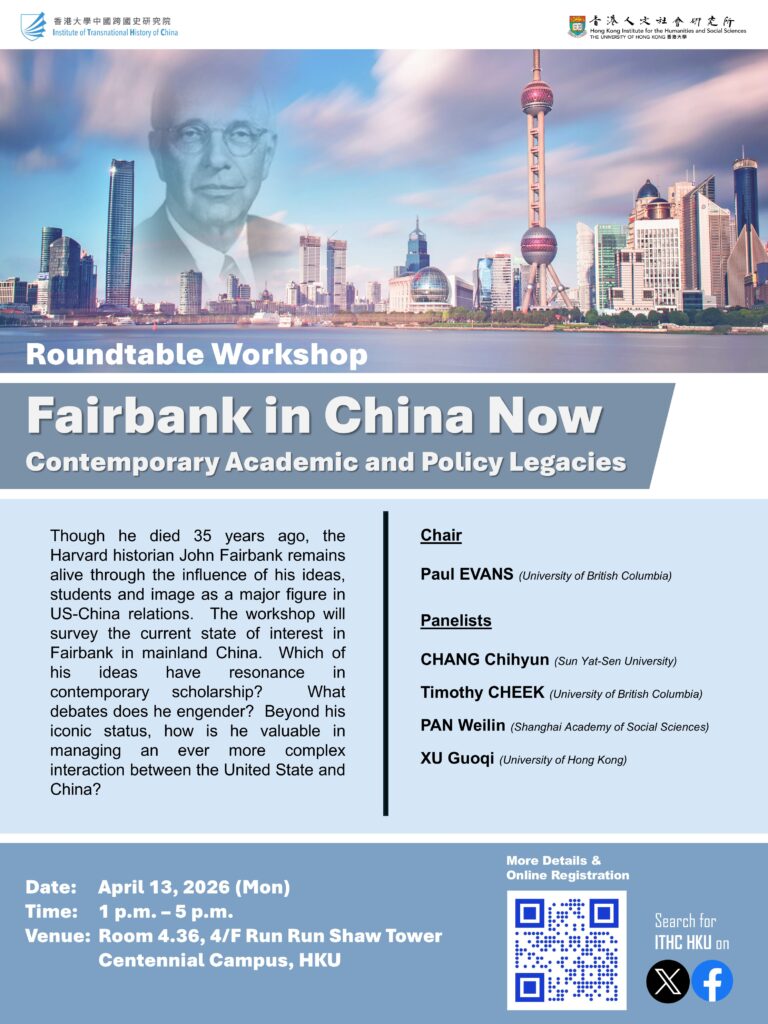
Though he died 35 years ago, the Harvard historian John Fairbank remains alive through the influence of his ideas, students and image as a major figure in US-China relations. The workshop will survey the current state of interest in Fairbank in mainland China. Which of his ideas have resonance in contemporary scholarship? What debates does he engender? Beyond his iconic status, how is he valuable in managing an ever more complex interaction between the United State and China? Online Registration Date: April 13, 2026Time: 1 p.m. – 5 p.m.Venue: Room 4.36, 4/F Run Run Shaw Tower, Centennial Campus, The University of Hong Kong 12:45 – 13:00Registration 13:00 – 13:10Welcome Remarks by Xu Guoqi(David H Y Chang Professor in Chinese HistoryFounding Director, Institute of Transnational History of ChinaUniversity of Hong Kong) 13:10 – 13:20Introduction by Paul Evans(Professor Emeritus, School of Public Policy and Global AffairsUniversity of British Columbia) 13:20 – 15:00Panel 1Chang Chihyun(Professor, Department of HistorySun Yat-Sen University)Pan Weilin(Associate Professor, Institute of China StudiesShanghai Academy of Social Sciences) 15:00 – 15:20Coffee Break 15:20 – 16:50Panel 2Timothy Cheek(Louis Cha Chair in Chinese Research, School of Public Policy and Global Affairs and Department of HistoryUniversity of British Columbia)Xu Guoqi(David H Y Chang Professor in Chinese HistoryFounding Director, Institute of Transnational History of ChinaUniversity of Hong Kong) 16:50 – 17:00Closing Remarks by Paul Evans(Professor Emeritus, School of Public Policy and Global AffairsUniversity of British Columbia)
Lecture Series by Professor Paul Evans
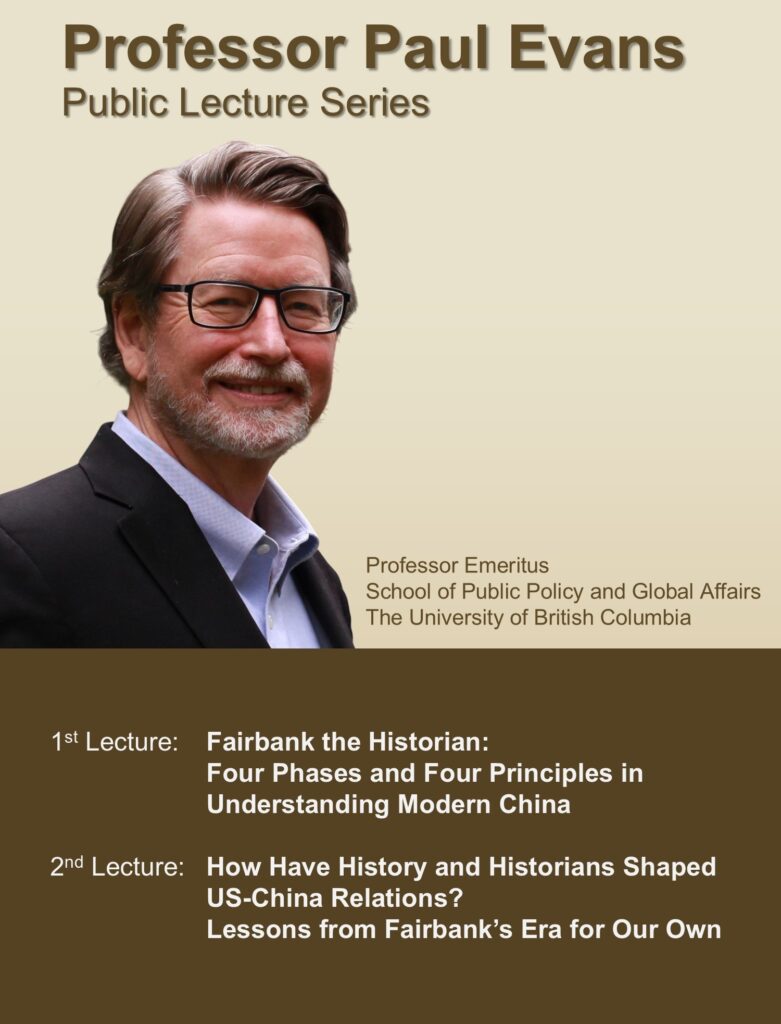
Speaker: Professor Paul Evans (Professor Emeritus, School of Public Policy and Global Affairs, The University of British Columbia) 1st Lecture Fairbank the Historian: Four Phases and Four Principles in Understanding Modern China Date: April 2, 2026 Time: 11:15 a.m. – 12:45 p.m. Venue: CPD-LG.09, LG/F, Centennial Campus, The University of Hong Kong Please click here to register online. 2nd Lecture How Have History and Historians Shaped US-China Relations? Lessons from Fairbank’s Era for Our Own Date: April 10, 2026 Time: 2:30 – 4:00 p.m. Venue: 4.36, 4/F Run Run Shaw Tower, Centennial Campus, HKU Please click here to register online.
Lecture Series by Professor Ma Min
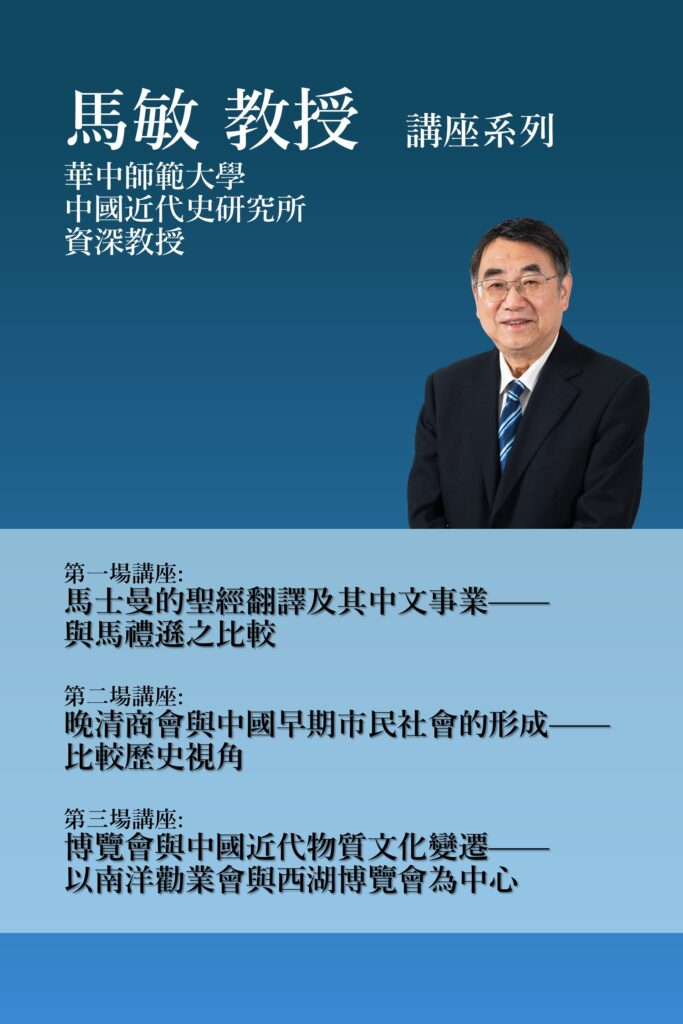
Lecture Series by Professor Ma Min 馬敏教授講座系列 The lecture series will be conducted in Putonghua. The following details are only available in Chinese: 主講: 馬敏教授華中師範大學中國近代史研究所資深教授 活動將以普通話進行 第一場講座: 馬士曼的聖經翻譯及其中文事業——與馬禮遜之比較日期: 2026年3月20日時間: 下午4:00 – 5:30地點: 香港大學百周年校園逸夫教學樓4.36室請按此處網上報名 第二場講座: 晚清商會與中國早期市民社會的形成——比較歷史視角日期: 2026年3月23日時間: 下午4:00 – 5:30地點: 香港大學梅堂地下演講廳 (May Hall G.01)請按此處網上報名 第三場講座: 博覽會與中國近代物質文化變遷——以南洋勸業會與西湖博覽會為中心日期: 2026年3月27日時間: 下午2:30 – 4:00地點: 香港大學百周年校園逸夫教學樓4.30室請按此處網上報名
Book Launch “The Idea of China: A Contested History”
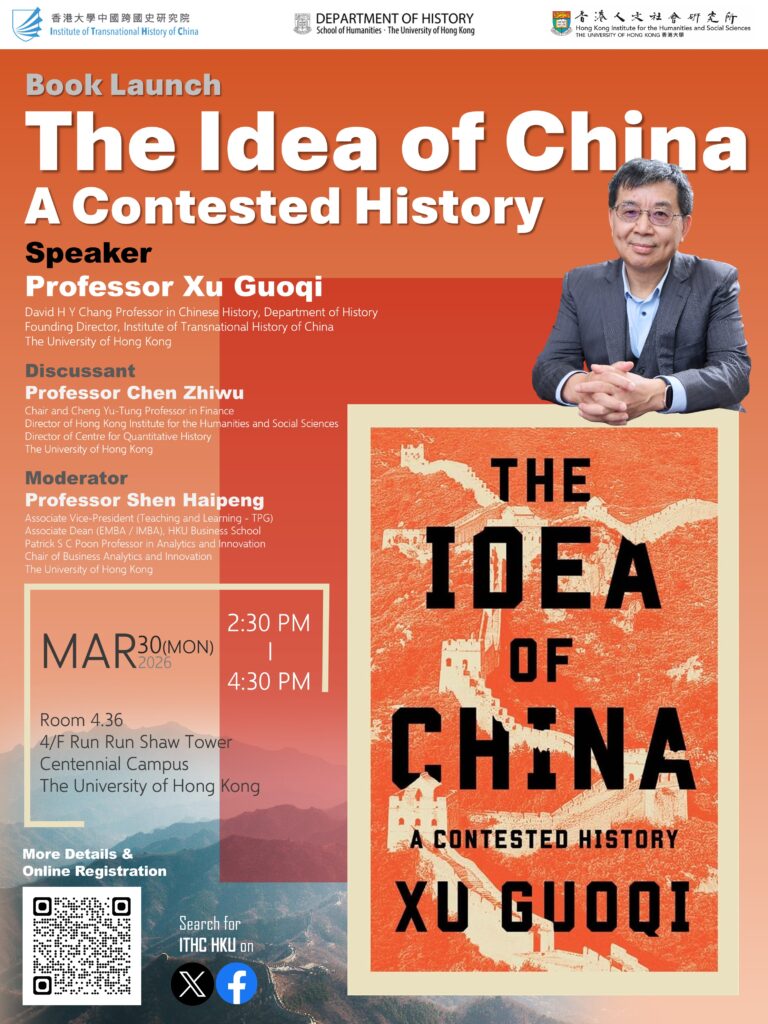
Click here for online registration Date: March 30, 2026Time: 2:30 p.m. – 4:30 p.m.Venue: Room 4.36, 4/F Run Run Shaw Tower, Centennial Campus, HKU SpeakerProfessor Xu GuoqiDavid H Y Chang Professor in Chinese History, Department of HistoryFounding Director, Institute of Transnational History of China The University of Hong Kong DiscussantProfessor Chen ZhiwuChair and Cheng Yu-Tung Professor in FinanceDirector of Hong Kong Institute for the Humanities and Social SciencesDirector of Centre for Quantitative History, HKU Business School HKU Business SchoolThe University of Hong Kong ModeratorProfessor Shen HaipengAssociate Vice-President (Teaching and Learning – TPG)Associate Dean (EMBA / IMBA), HKU Business SchoolPatrick S C Poon Professor in Analytics and InnovationChair of Business Analytics and Innovation The University of Hong Kong Brief Introduction An acclaimed historian’s bold response to two simple, yet vexed, questions: What counts as China, and who counts as Chinese? China became a capitalist superpower by investing in globalization. Now that it has established its credentials—and emerged as a major US competitor—its leaders are looking within, focused on suppressing dissent and fostering cohesion. The result has been an increasingly nationalist cultural agenda, celebrating a Chinese identity steeped in the mystique of the Middle Kingdom and nostalgia for heroic twentieth-century resistance. Yet Chinese nationalism, like nationalism everywhere, is fraught. Few Westerners, and even fewer Chinese, recognize that the very idea of China is up for grabs. In this sweeping history, Xu Guoqi explores the transnational construction of Chineseness. The Idea of China describes an identity constantly under renovation. Through dialogue and confrontation with neighbors, more distant outsiders, and Chinese speakers and writers within the state, Hong Kong, Taiwan, and the diaspora, the idea of China has been reshaped repeatedly across time. Even bedrock cultural formations like Confucianism have been reimported to China after their translation in Korea, Japan, Vietnam, and elsewhere. The idea of China has always been and remains a continuing process, invented, subverted, and reinvented to serve the shifting needs of kings and bureaucrats, industrialists and intellectuals, allies and adversaries. Xu’s chronicle is as provocative as it is rigorous, and his conclusion could hardly be starker: China, fundamentally, is constituted by a shared history. To accept this is to begin moving past the heated great-power rivalries that threaten international peace and stability today.
Book Launch “Sports as Method: An Alternative Approach to Study Chinese Tradition and Civilization”
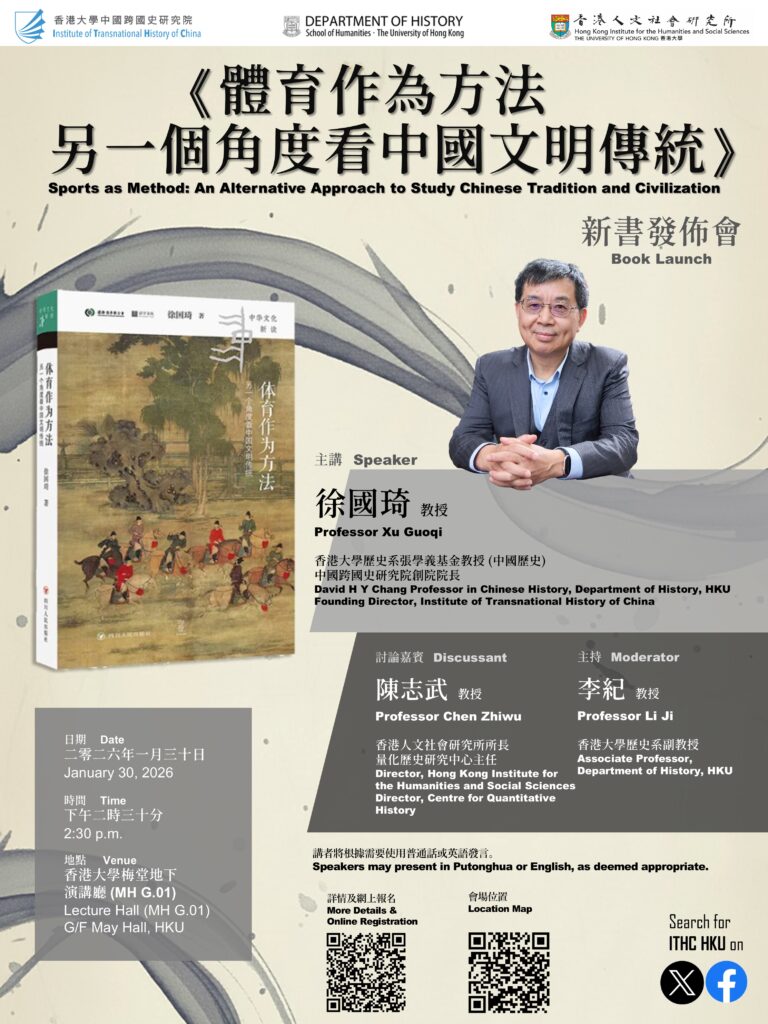
Date: January 30, 2026 Time: 14:30 Venue: MH G.01, May Hall SpeakerProfessor Xu GuoqiDavid H Y Chang Professor in Chinese History, Department of History, HKUFounding Director, Institute of Transnational History of China DiscussantProfessor Chen ZhiwuDirector, Hong Kong Institute for the Humanities and Social SciencesDirector, Centre for Quantitative History ModeratorProfessor Li JiAssociate Professor,Department of History, HKU Speakers may present in Putonghua or English, as deemed appropriate. Brief Introduction (Chinese only)這並不是一本就體育談體育的書,而是體育的文化史、文明史和文化交流史。它意欲借助體育來解讀中國文明特性,揭示中外文明互鑒、交流,彰顯中國與其他文明「共有」的歷史、共同的旅程。 See Event Photos
International Symposium on Transnational History of China
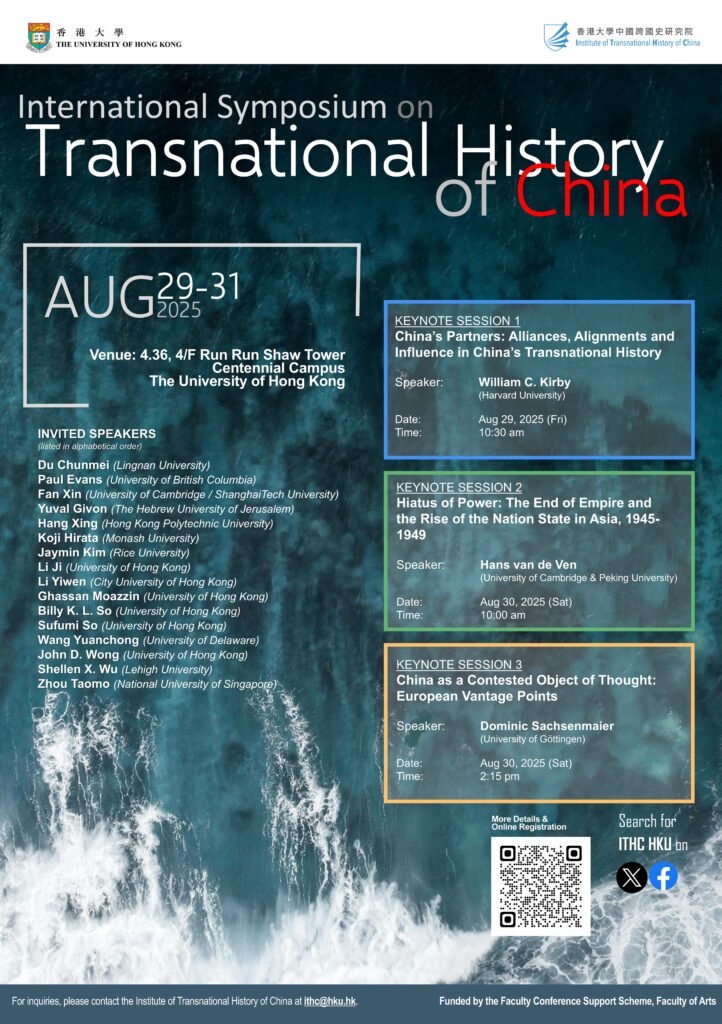
International Symposium on Transnational History of China Date: 29 – 31 Aug 2025 Venue: Room 4.36, 4/F Run Run Shaw Tower, Centennial Campus, HKU Day 1 – 29 August 2025 (Friday) Morning Session 9:30 – 10:00 Registration 10:00 – 10:15 Opening Remarks by David Pomfret 10:30 – 11:40 Keynote Session 1 China’s Partners: Alliances, Alignments and Influence in China’s Transnational History William C. Kirby (Harvard University) Afternoon Session 13:50 – 15:10 Panel 1 Seeking Justice for All Sentient Beings: Lü Bicheng’s Feminist Vegetarianism Du Chunmei (Lingnan University) The Last Boat back to China: Xiao Qian and the Transnational Biography Fan Xin (University of Cambridge / ShanghaiTech University) 15:20 – 17:20 Panel 2 Beyond the Perspectives of National and Transnational Histories: A Coevolutionary Approach to Researching and Writing History in the Age of Post-Globalisation Billy K. L. So (University of Hong Kong) Sufumi So (University of Hong Kong) Fairbank and the Making of an International History of China Paul Evans (University of British Columbia) Cloud Computing 1.0 Shellen X. Wu (Lehigh University) Day 2 – 30 August 2025 (Saturday) Morning Session 9:30 – 10:00 Registration 10:00 – 11:10 Keynote Session 2 Hiatus of Power: The End of Empire and the Rise of the Nation State in Asia, 1945-1949 Hans van de Ven (University of Cambridge & Peking University) 11:10 – 13:10 Panel 3 Takasaki Tatsunosuke and the Politics of Early PRC-Japan Trade, 1949–1964 Koji Hirata (Monash University) Legal Codes in Chosŏn, Qing, and Nguyễn States: A Preliminary Analysis of Early Modern Sinitic Law Jaymin Kim (Rice University) The Rise of Andong in the Political and Trade Networks in Northeast Asia, 1630s-1930s Wang Yuanchong (University of Delaware) Afternoon Session 14:15 – 15:25 Keynote Session 3 China as a Contested Object of Thought: European Vantage Points Dominic Sachsenmaier (University of Göttingen) 15:40 – 17:40 Panel 4 Electrifying Consumers: Advertisements and the Promotion of Electricity in Republican Shanghai, 1912-1937 Ghassan Moazzin (University of Hong Kong) Hong Kong Dollar: Mediating China’s Participation in Global Capitalism since the Nineteenth Century John D. Wong (University of Hong Kong) From Military-Industrial Complex to Global Supply Chain: A History of the Electronics Industry in Shenzhen, China Zhou Taomo (National University of Singapore) Day 3 – 31 August 2025 (Sunday) Morning Session 9:30 – 10:00 Registration 10:00 – 11:20 Panel 5 Constructing a Heavenly Realm: State, Buddhism, and Sino-Japanese Relations in the Yuan-Ming Transition Li Yiwen (City University of Hong Kong) Hakka Chinese in the Caribbean: Race, Religion, and Identity from the 1850s to 1940s Li Ji (University of Hong Kong) Qiu Zichan (University of Illinois Chicago) 11:20 – 12:40 Panel 6 An Early-Modern Broadcast: News of the Manchu Conquest of China in the Jesuit Annual Letters, 1644–1649 Yuval Givon (The Hebrew University of Jerusalem) Ming Loyalists in Southern Vietnam: New Evidence and Interpretations Hang Xing (Hong Kong Polytechnic University) 12:40 – 13:00 Closing Remarks by Xu Guoqi The Symposium is funded by the Faculty Conference Support Scheme, Faculty of Arts. See Event Photos
After Globalisation: A Brief History of the Twenty-First Century (Prof. Jeremy Adelman, Princeton University & University of Cambridge)
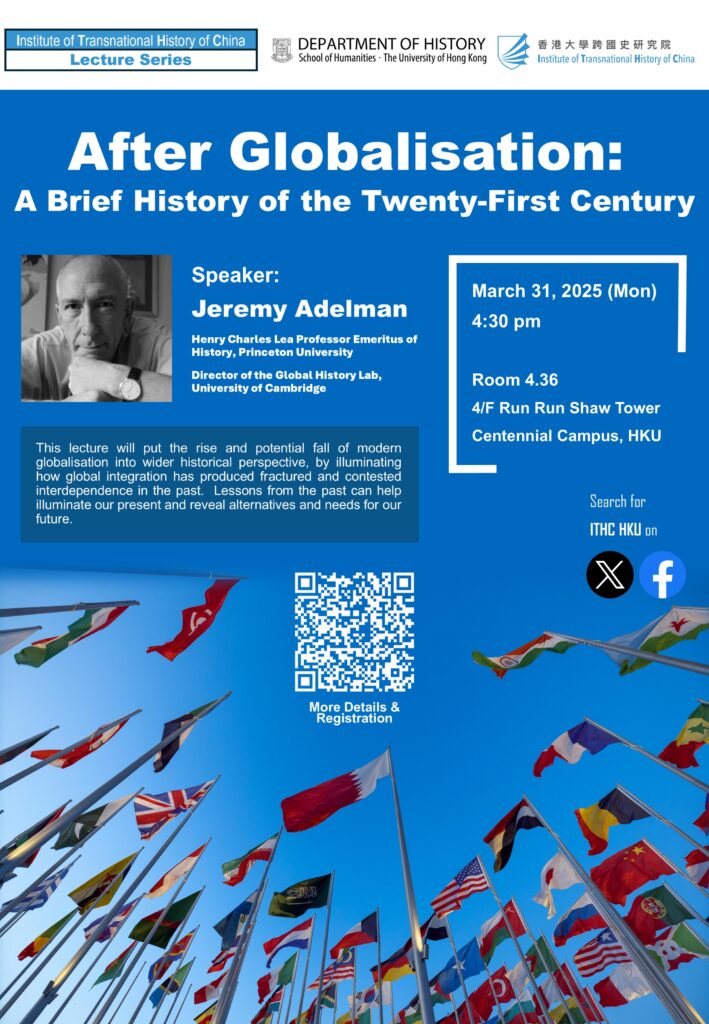
After Globalisation: A Brief History of the Twenty-First Century(Prof. Jeremy Adelman, Princeton University & University of Cambridge) Date: 31 March 2025 Time: 4:30 pm Venue: Room 4.36, 4/F Run Run Shaw Tower, Centennial Campus, HKU See Event Photos
Internationalism, Identity, and Ideology in the Shaping of Postwar China, and the Legacy for Today (Prof. Rana Mitter, Harvard Kennedy School)
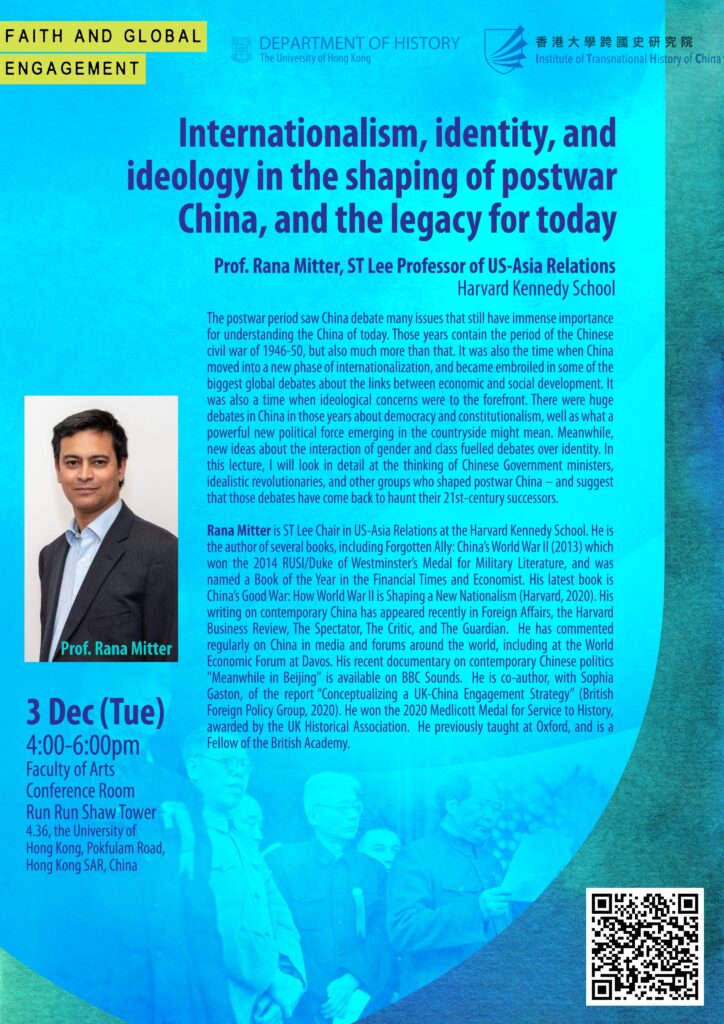
Internationalism, Identity, and Ideology in the Shaping of Postwar China, and the Legacy for Today (Prof. Rana Mitter, Harvard Kennedy School) Date: 3 December 2024 Time: 4:00 pm Venue: Room 4.36, 4/F Run Run Shaw Tower, Centennial Campus, HKU See Event Photos