


本活動將以英語進行,以下活動資料只提供英文版本。
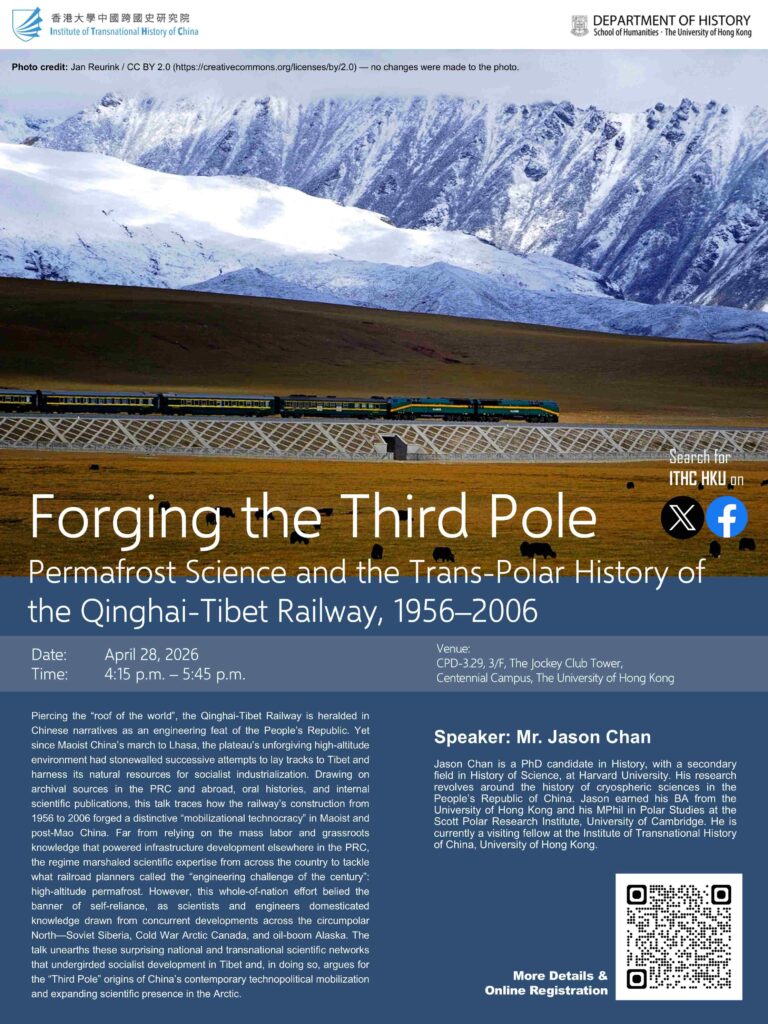
Date: April 28, 2026
Time: 4:15 p.m. – 5:45 p.m.
Venue: CPD-3.29, 3/F, The Jockey Club Tower, Centennial Campus, The University of Hong Kong
Piercing the “roof of the world”, the Qinghai-Tibet Railway is heralded in Chinese narratives as an engineering feat of the People’s Republic. Yet since Maoist China’s march to Lhasa, the plateau’s unforgiving high-altitude environment had stonewalled successive attempts to lay tracks to Tibet and harness its natural resources for socialist industrialization. Drawing on archival sources in the PRC and abroad, oral histories, and internal scientific publications, this talk traces how the railway’s construction from 1956 to 2006 forged a distinctive “mobilizational technocracy” in Maoist and post-Mao China. Far from relying on the mass labor and grassroots knowledge that powered infrastructure development elsewhere in the PRC, the regime marshaled scientific expertise from across the country to tackle what railroad planners called the “engineering challenge of the century”: high-altitude permafrost. However, this whole-of-nation effort belied the banner of self-reliance, as scientists and engineers domesticated knowledge drawn from concurrent developments across the circumpolar North—Soviet Siberia, Cold War Arctic Canada, and oil-boom Alaska. The talk unearths these surprising national and transnational scientific networks that undergirded socialist development in Tibet and, in doing so, argues for the “Third Pole” origins of China’s contemporary technopolitical mobilization and expanding scientific presence in the Arctic.
Speaker: Mr. Jason Chan
Jason Chan is a PhD candidate in History, with a secondary field in History of Science, at Harvard University. His research revolves around the history of cryospheric sciences in the People’s Republic of China. Jason earned his BA from the University of Hong Kong and his MPhil in Polar Studies at the Scott Polar Research Institute, University of Cambridge. He is currently a visiting fellow at the Institute of Transnational History of China, University of Hong Kong.